
A group of researchers from the Reincarnate project published the data article “Concreting a sustainable future: A dataset of alkali-activated concrete and its properties” in the ELSEVIER journal. The publication aims to introduce a dataset comprising 1630 alkali-activated concrete (AAC) mixes, compiled from 106 literature sources. With this paper, Benjamin Moreno Torres, Rafia Firdous from the Technical University of Berlin (TUB) and Christoph Völker from partner Bundesanstalt für Materialforschung und -prüfung (BAM) have advanced the ground for researchers and industry professionals offering insights into the environmental benefits of substitution traditional Portland concrete with AAC.
Concrete is widely used in construction, and cement, in particular, contributes to 8% of global CO2 emissions. Therefore, the industry is looking for alternative methods, such as AAC, which has the potential to significantly lower these emissions compared to ordinary Portland concrete. By offering this standardised dataset, the Reincarnate team promotes collaboration among researchers and facilitates research in the AAC field.
“Our publication underlines the importance of providing a high-quality dataset that can be readily used in various data-extensive research areas like machine learning and theoretical validation. We described common features grouped into nine categories, corresponding compressive strength values from the laboratory, and the calculated carbon footprint. The data is presented comprehensively, accurately, and user-friendly so that the community of researchers finds it helpful and even reviews and augments it,” expressed Benjamin Moreno Torres.
Validating and curating data
The validation and curation process involved removing redundancies, correcting outliers, maintaining integrity through duplicate removal, verifying specimen details and test timings, and excluding interpolated mixtures to ensure real-world relevance. Moreover, a heuristic equation was used to calculate the carbon footprint of each AAC mixture, considering the material production and curation processes.
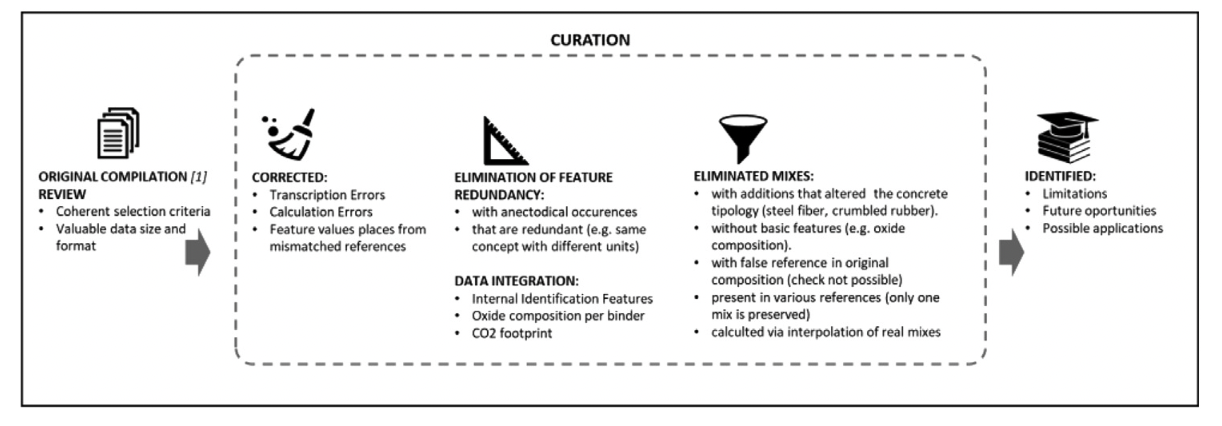
Find the datasets here!
Datasets limitations
The dataset, while valuable, has certain limitations. It spans a limited time frame, potentially missing relevant studies beyond this period. Additionally, representing curing processes in a tabular format proves challenging due to inconsistent presentation across different studies. Furthermore, the carbon footprint calculations are simplified and overlook crucial factors like material transportation and mass production.
Nevertheless, the dataset remains an essential tool for pinpointing research gaps, crafting predictive models, and evaluating AAC concretes’ performance in the industry. Users are advised to normalise features and apply filtering and selection based on their specific research requirements to maximise utility.
Read the full paper here!
Stay tuned to our research developments by subscribing to our newsletter and follow us on LinkedIn and Twitter so you don’t miss a thing!
Read our previous articles on research works regarding materials: