Demonstrators
Demonstration,piloting andfirst market replication
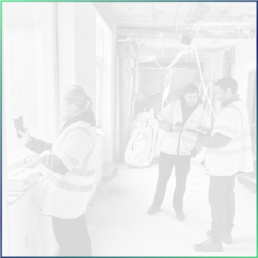
Building a tiny house with reused materials and products
Location
Berlin, Germany
Partner in charge
Summary
This project demonstrates a smart tiny house that combines circular construction, prefabrication, and robotic assembly to create a scalable, affordable, and sustainable housing solution. By using recycled materials and a modular design system, it enables mass customization while maintaining manufacturing efficiency. A fully functional prototype was produced off-site and assembled with robotic assistance, proving the viability of automated construction using secondary materials.
Results show significant reductions in material waste, embodied carbon, and construction time, along with the potential for 20–40% cost savings at scale. The prototype demonstrates a practical pathway from traditional bespoke construction to a standardized, circular, and digitally driven housing system.
Learn more
Circular decision-making for real estate assets
Location
Paris, France
Partner in charge

Summary
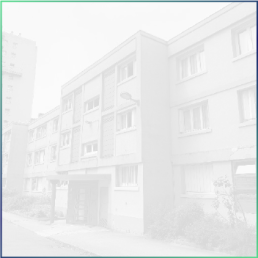
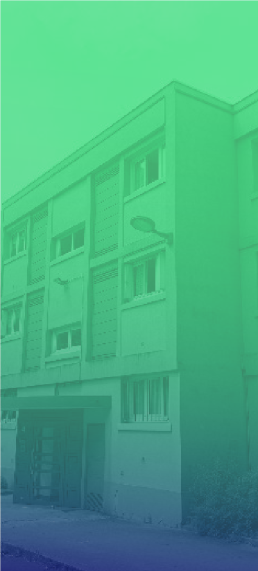
The Paris Habitat demonstration applies a participatory, multi-level circular decision-making process developed by TU Delft to guide the renovation and densification of a 1950s social housing complex. The process connects strategic, scenario, and product-level thinking
—combining Cross-Impact Balance (CIB) analysis, Analytic Hierarchy Process (AHP), and Fuzzy-TOPSIS to explore and rank circular renovation pathways.
Supported by AI-based visualisation and narratives, it helps align technical, social, and environmental priorities, clarify trade-offs, and extend the use life of real estate assets through a transparent and replicable approach.
Learn more
BIM-Based Prefab Element Tracking - Lagemaat
Location
Heerde, Netherlands
Partner in charge
Summary
This demonstration showcases a BIM-based system that supports circular construction by tracking individual building components throughout dismantling, reuse, and reconstruction. Using QR code identification, physical elements are linked to their digital records, enabling real-time access, updates, and management of component information on site.
The result is a dynamic digital model of the donor building in which each element is uniquely identified and continuously monitored. This improves transparency, coordination, and efficiency in reuse processes while providing a foundation for broader circular construction applications.
Learn more
Downstream demonstrator, downstream gate, circular feedstock
Location
Göteborg, Sweden
Partner in charge
Summary
This study is an exploration of how SLAMD can help shorten the experimental time of developing new recipes with alternative binders from CDW (glass and concrete) for new concrete production. The expected outcomes are SLAMD could be able to suggest and predict recipes that fulfill the requirement (compressive strength).
Learn more

Circular material flows - Flat glass to flat glass
Location
Teknikhöjden, Stockholm, Sweden
Partner in charge
Summary
This demonstration focuses on illustrating a circular value flow where flat glass from existing buildings is recovered, processed, and used to produce new flat glass, ultimately reinstalled as a window component. The aim is to show how both the physical movement of materials and the flow of information are essential for enabling circularity.
A key aspect of circular physical flows is the timely exchange of accurate data. Each actor in the value chain must be able to share and access relevant information at the right moment. In this context, the demonstration highlights how material can be traced both physically
and digitally across different steps in the value chain.
The demonstration also shows how Circular Value Flow Planning (CVFP), along with the required digital capabilities, is integrated into the CP-IM platform. This includes using data for circularity assessments and strategic material planning.
Learn more
Inventory of the material bank
Location
Teknikhöjden, Stockholm, Sweden
Partner in charge
Summary
This demonstration focuses on different inventory methods for identifying flat glass recycling and finding a method for transferring information between different software/programs and actors. This to secure that flat glass from existing buildings is recovered, processed, and
used to produce new flat glass, ultimately reinstalled as a window component. The aim is to show how the inventory with a structured methodology and dataset enable the physical movement of components and the flow of information for enabling circular material flows.
The demonstration also shows how Circular Value Flow Planning (CVFP), along with the required digital capabilities, is integrated into the CP-IM platform. This includes using data for circularity assessments and strategic material planning.
Learn more
Application of non-destructive testing methods for the assessment and prediction of wooden roof truss serviceability
Location
Berlin, Germany
Partner in charge
Summary
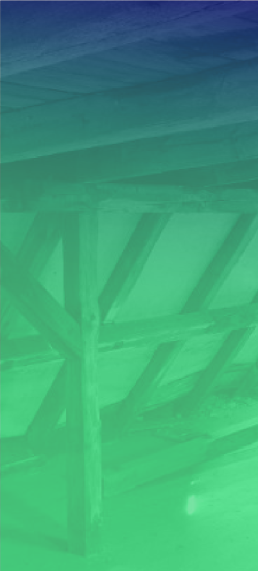
This demo case explores the use of non-destructive testing (NDT) methods to assess and predict the serviceability of wooden roof trusses. Focusing on moisture-related degradation, the research combines manual inspections with continuous sensor monitoring on two real-world case studies (Werdau and Berlin-Pankow). The findings show that continuous monitoring provides deeper insights into moisture-driven damage processes than visual inspections alone. By integrating inspection data with real-time environmental measurements, the approach enables a more accurate condition assessment and supports predictive lifecycle frameworks. This contributes to better maintenance, extended component life, and digital tools for circular construction within the REINCARNATE project.
Learn more
AI-Based Non-Destructive Crack Detection in Masonry Structures
Location
Berlin, Germany
Partner in charge
Summary
This study presents an AI-based, non-destructive approach for detecting and assessing cracks in masonry structures using image data. Employing machine learning and deep learning techniques on a custom-annotated dataset of masonry surface images, the method automatically identifies and segments crack patterns at both the classification and pixel level. Results show that deep learning models reliably detect and delineate cracks, offering improved consistency and scalability over manual visual inspections. The work supports data-driven condition assessment and lifecycle-oriented decision-making within the REINCARNATE project framework.
Learn more

Kathreiner Haus demonstration
Location
Berlin, Germany
Partner in charge
Summary
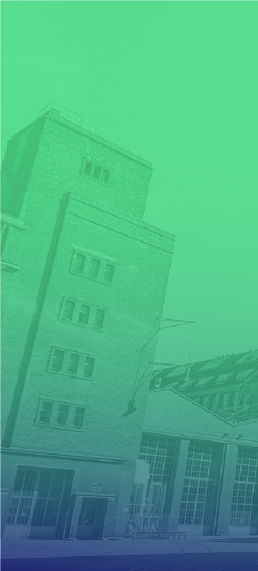
The Kathreiner Haus project (Streamlining BIM Procurement for a circular economy) develops a Dynamo for Revit tool to automatically integrate reclaimed building components into BIM designs. This innovation drastically cuts material waste, and aligns with the Reincarnate mission to create closed-loop material cycles.
Learn more
High-rise building in China
Location
Wuhan, China
Partner in charge


Summary
The demonstrator ‘’Autonomous Robotic System for On-site Construction Waste Assessment and Separation in Wuhan’’ deploys an autonomous mobile robot for real-time, on-site construction and demolition (C&D) waste sorting.
By integrating YOLOv8 visual detection with Near-Infrared (NIR) material verification, the system identifies and retrieves 6 key waste categories: concrete, metal, wood, plastic, mixed rubble, and hazardous materials. The goal is to replace hazardous manual sorting, reduce logistical costs of mixed waste transport, and achieve a 60% recycling rate.
Learn more