
The built environment faces several challenges. The average lifespan of buildings is only 34 years, and the sector accounts for 33% of human-induced emissions. Unthinkably, 40% of the world’s resources are used in construction, and the industry generates 40% of the world’s waste! Such challenges allow circular practices like Adaptive Reuse (AR) to gain prominence in addressing these issues.
To contribute to this practice particularly, a group of researchers from the Technical University of Delft (TUD) published the paper titled “What matters when? – An integrative literature review on decision criteria in different stages of the adaptive reuse process” in the Journal of Developments in the Built Environment. In this publication, Brian van Laar, Angela Greco, Hilde Remoy and Vincent Gruis provide a comprehensive overview of the decision criteria for AR throughout the process.
But first, what does it mean? AR refers to extending the useful life of historic, old, obsolete, and derelict buildings. It involves maximising the reuse and retention of existing structures and fabrics. AR is important as it provides social, environmental, and economic benefits, including energy and material efficiency, safety, and better quality of living.
“Our study will serve as the foundation for a circular decision-making framework for the adaptive reuse and renovation of real estate assets as part of the Reincarnate project. We believe that this is the first literature review to take a process perspective, focusing on specific phases of adaptive reuse and systematically examining the interrelationships and distinctions between decision criteria across the different phases. We are very proud of this achievement,” affirmed Brian van Laar, PhD Researcher at TUD.
Advancing the Theory
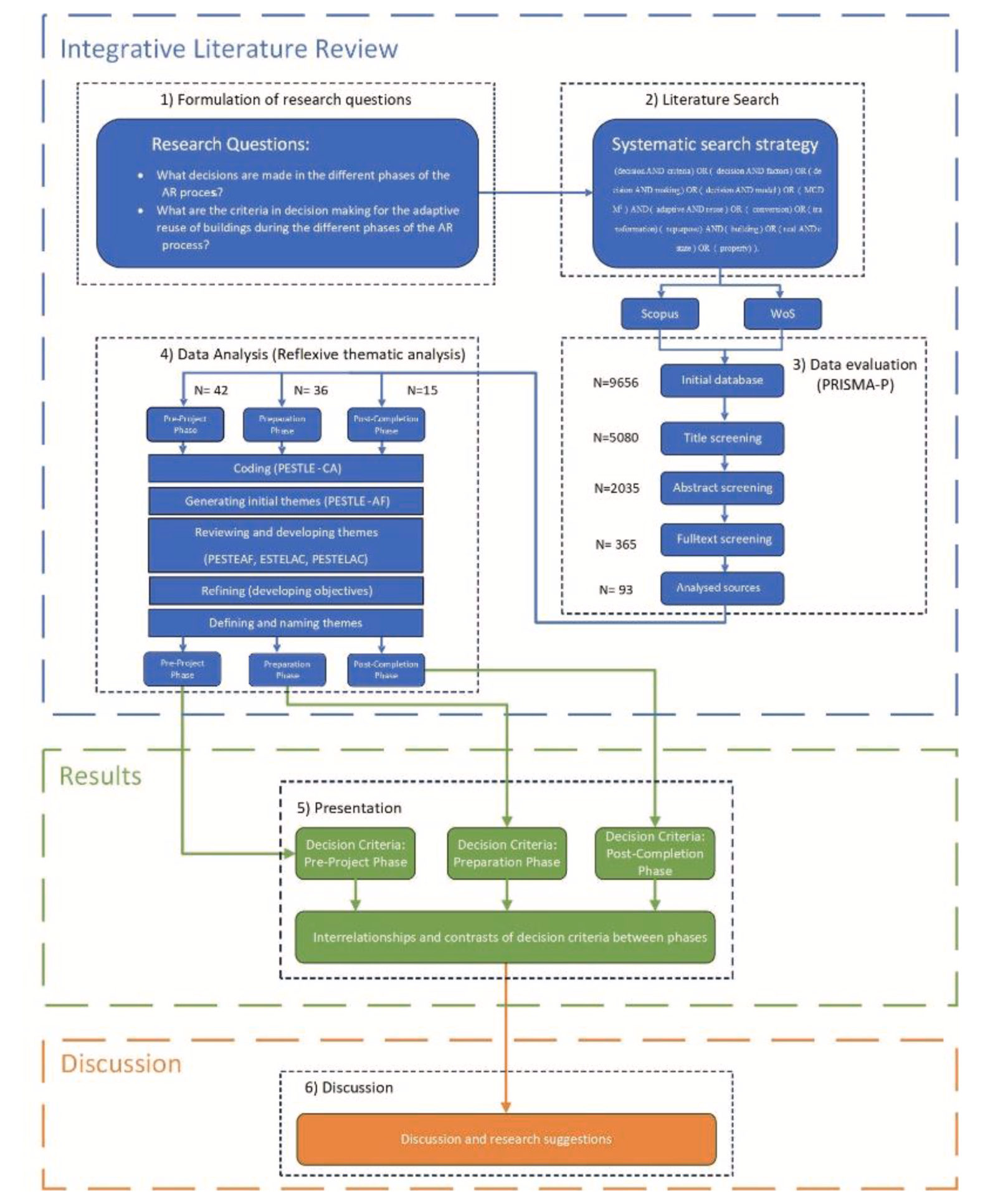 The research follows an integrative review approach to identify decision criteria for different phases in adaptive reuse. This is significant because, unlike other reviews, their approach helps generate unique perspectives by synthesising existing research to contribute to theory.
The study follows a multi-step process that includes formulating review questions, conducting a literature search, data evaluation, analysis, and synthesis. The study categorises decision criteria for various phases of the adaptive reuse process (pre-project phase, preparation phase, and post-completion phase). These decision criteria are then used in each phase to make crucial decisions about the adaptive reuse of buildings. The decisions range from the decision to preserve, reuse, or demolish in the pre-project phase to selecting the best alternative use or design scenario in the preparation phase.
In the end, they conducted a reflexive thematic analysis and created a comprehensive list of decision criteria and objectives. This helps better understand the decision-making process in adaptive reuse projects.
Calling for more Research and Practical Cases
TUD’s work is just the beginning of a long journey. Their publication recommends further research to advance the literature on decision criteria for adaptive reuse. Based on their findings, for instance, future researchers should prioritise the dynamic nuances of criteria and explore specific evaluation methods. Empirical validation through case studies and stakeholder engagement is mentioned to be crucial. Adopting a “building segmentation” perspective and developing comprehensive scenarios in decision-making models can improve frameworks. Environmental criteria should also be broadened.
All in all, further investigation is necessary to bridge the gap between theoretical concepts and practical implementation. The TUD team is convinced that more research can drive innovation and sustainability in adaptive reuse practices and boost the circular transformation.
“We invite researchers and practitioners to unpack the dynamics of the implementation and post-completion – phases. While much more research is needed to ensure the future adaptability of buildings, for example, through better design practices for dissembly, our paper reveals crucial decision-making criteria already pivotal at various stages of the adaptive reuse process,” expressed Angela Greco, Assistant Professor at TUD.
Read the full paper here!
Stay tuned to our research developments by subscribing to our newsletter and follow us on LinkedIn and Twitter so you don’t miss a thing!