
On 4 June 2025, our project coordinator Technische Universität Berlin published an article exploring how Reincarnate is helping shift the construction sector away from a wasteful linear model and towards circular practices that prioritise reuse, recovery, and smart design.
At the Swedish company Ragn-Sells, IT specialists are currently building a digital database that records all raw materials recovered during demolition. Meanwhile, in Germany, researchers have developed an AI-powered tool that uses this database to design new building materials from the recovered elements. This tool is one of ten digital innovations developed within the Reincarnate project, which are now being tested across thirteen pilot projects in Europe and China. The collaboration between science and industry is at the core of the project, which is focused on helping the construction sector shift from a linear system to a sustainable, circular one.
“So far, the construction industry has followed a simple logic: build, use, demolish,” says Dr Timo Hartmann, Professor of Systems Engineering for Built Facilities at TU Berlin and coordinator of the project. “We need to leave behind this linear and environmentally harmful approach — not only for the sake of the planet, but also because Europe is facing growing resource scarcity and, due to geopolitical shifts, will no longer have secure access to materials as it once did.”
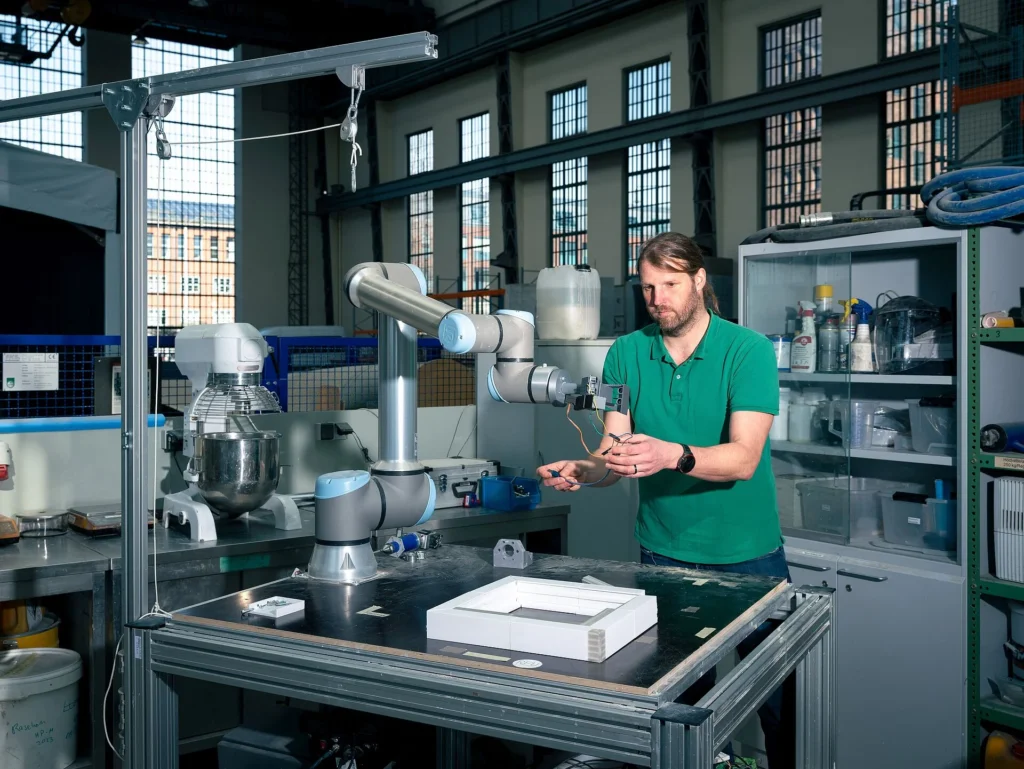
In the Peter Behrens Hall at TU Berlin, Hartmann and his team are using a small robotic arm to investigate how single-glazed windows can be dismantled without damage and reassembled into multi-glazed units. The robot-based method allows components to be reused and entire facades to be redesigned using recovered elements.
Currently, buildings in Europe are typically demolished after around 40 years of use. Most of the components — windows, doors, pipes, drywall — end up in landfills. In the best-case scenario, the debris is reused as backfill in road construction. Construction and demolition waste account for 25 to 30 percent of all waste generated in Europe.
To establish a circular economy in construction, the Reincarnate project focuses on two main goals. First, to extend the lifespan of existing buildings, building products, and materials. Second, to ensure that materials which have reached the end of their life can be recycled into new, high-quality building components. Examples under investigation at TU Berlin include the automated and damage-free removal of doors so they can be reused in other buildings, and the robotic disassembly of windows for reintegration into new construction projects.
The ten digital innovations developed in the project focus on tracking and managing building materials and waste, creating automated solutions for dismantling and separating materials, and delivering cross-sector innovations in construction products and materials. These solutions are being tested not only with Ragn-Sells, but also through the renovation of properties managed by Berlin’s real estate authority, in outdated buildings in Amersfoort in the Netherlands, during the automated inspection of a hotel in Hong Kong, and through the demolition of three wastewater treatment plants and the construction of a new one in Spain.
Original article in German: “Zu wertvoll für die Deponie” by Sybille Nitsche, published by TU Berlin on 4 June 2025.
👉 Read the full article (German)