
How can non-destructive testing support more informed decisions on building reuse?
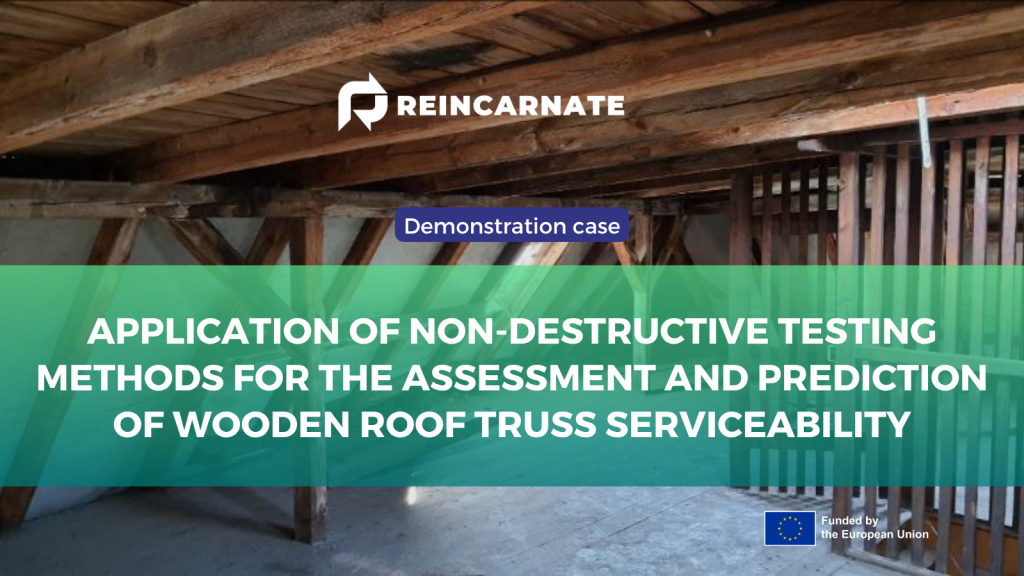
The Reincarnate demonstration on timber roof structures explores this topic. The study was conducted at two real-world sites in Germany, Werdau and Berlin-Pankow, with a focus on assessing wooden roof trusses and their long-term serviceability under varying environmental conditions.
Check the one-pager
The approach combines traditional inspection with continuous sensor-based monitoring. Moisture sensors embedded directly into the timber elements record internal conditions, while temperature and relative humidity are tracked simultaneously. This allows the material’s behaviour to be observed over time, rather than relying solely on visual assessments. Data is transmitted to a cloud platform, enabling real-time access and continuous evaluation of structural performance.
Check the three pager
The results show clear differences between the two cases. In Werdau, where the roof structure is affected by moisture ingress, wood moisture levels reached up to 17–18% during the short monitoring period. In contrast, the renovated structure in Berlin-Pankow showed more stable conditions over three months, with values generally ranging between 13% and 19%. In both cases, fluctuations in moisture content closely followed changes in ambient humidity, highlighting the direct influence of environmental conditions on structural behaviour.
By providing continuous, data-driven insight into material condition, the demonstration supports earlier identification of potential degradation and more targeted maintenance strategies. This contributes to extending the lifespan of existing structures and reducing unnecessary demolition.