
This article presents a demonstrator case from the Reincarnate project, which has developed digital and practical solutions to help the construction sector transition from linear waste handling to high-value circular material flows.
When Akademiska Hus began dismantling the Teknikhöjden building in Stockholm, they chose to do something entirely new – transforming a demolition project into a circular pilot project. Together with Ragn-Sells and Saint-Gobain, they have created Sweden’s first industrial circular loop for flat glass, where windows from the old building become raw material for new flat glass. The result demonstrates how property owners and construction companies can cut the climate impact of windows in half, conserve resources, and make circularity a reality.
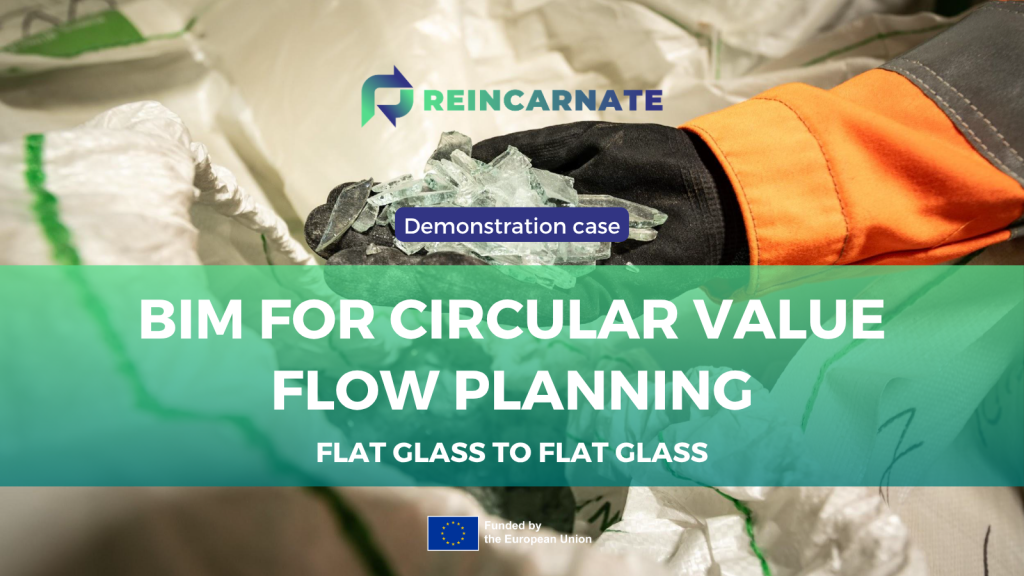
Check our one pager Circular material flows: Flat glass to flat glass
Every year, 35,000 tonnes of flat glass are landfilled in Sweden – one of the construction sector’s most energy-intensive materials. Although the material can be recycled almost infinitely, more than 90 percent goes straight to landfill. Producing new flat glass requires vast amounts of energy and virgin silica sand — a critical and finite resource. Meanwhile, demands for traceability, climate reporting, and circular materials in construction projects are steadily increasing.
The solution: an industrial circular loop for flat glass. To meet these demands and accelerate the climate transition, Ragn-Sells, in collaboration with Saint-Gobain, has established Sweden’s first industrial chain for the circular recycling of flat glass – from dismantling to new windows.
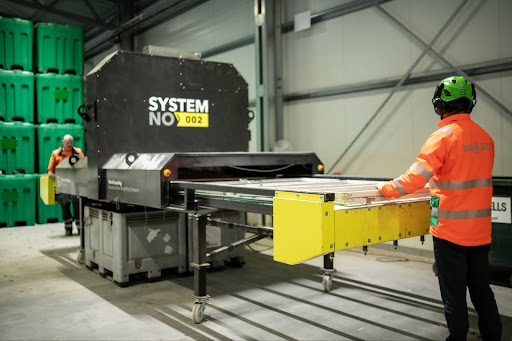
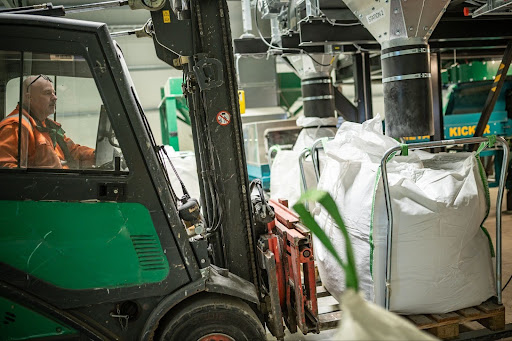
In Örebro, Ragn-Sells has built the country’s first circular recycling facility for flat glass. The plant can process up to 10 tonnes of glass per hour, covering all of Sweden’s needs and parts of Norway’s. Here, the glass is separated, crushed, and quality-assured using advanced optical technology that guarantees material purity. It is then transported to Saint-Gobain’s facility in Germany to become new raw material for their lowest-carbon window glass.
Results:
- Up to 53% lower climate impact compared to virgin glass
- Approximately 30% lower energy consumption
- Reduced demand for virgin silica sand
Akademiska Hus leads the way. For circular windows to become a reality, glass must first be collected from demolitions and renovations. Collection is the key to a functioning circular loop. Akademiska Hus, which aims to achieve net-zero across all operations by 2040, is now developing a long-term circularity roadmap to identify and prioritise measures that increase resource efficiency, strengthen economic value, and reduce climate impact. The Teknikhöjden building plays an important role in this work.
When the building was scheduled for dismantling, the project became an innovation testbed to explore new working methods and business models for reuse and recycling – especially of heavy building components such as concrete and natural stone, but now also flat glass.
“We need circular solutions to become standard in the construction sector. The fact that we as a property owner can actively feed high-quality raw material into new material flows shows that recycling is not only possible – it is a strategic necessity for future-proofing the industry and securing access to window glass. If we continue consuming virgin silica sand at today’s rate, we will run out within 60 years,” says Jörgen Olofsson, Project Manager at Akademiska Hus and responsible for the flat glass in the Teknikhöjden project.
Check our three pager Flat glass to flat glass. A demonstration of the innovation BIM for circular value networks
For Akademiska Hus, Ragn-Sells developed a digital copy of the building. This made it possible, even before dismantling began, to inventory the number of windows, identify their types, and measure geometry, volume, and weight. The digital twin also enabled efficient planning of handling and logistics. It took just over ten minutes to identify 10.2 tonnes of windows suitable for flat glass recycling.
This approach strongly connects with the goals of the Horizon Europe project Reincarnate, in which Ragn-Sells is a project partner. Reincarnate is developing digital and practical solutions to improve how construction products and materials are identified, traced, assessed and reused across their life cycles, helping turn waste streams into higher-value circular resource flows.
The flat glass case reflects this ambition in practice. By using digital building data to identify recoverable windows before dismantling, and by creating a traceable pathway from demolition to new production, the initiative shows how circular value chains can become more transparent, scalable and replicable, which is fully in line with Reincarnate’s wider work on circular potential assessment, material traceability and reuse in construction.
A total of 135 windows weighing 10.2 tonnes are being dismantled from Teknikhöjden. The glass is handled as waste, but instead of being landfilled, it is recycled into new raw material – becoming part of the circular glass loop. This represents a major shift from linear waste handling to a system where waste becomes a valuable resource.
“Akademiska Hus shows what is possible when property owners take an active role in the climate transition. We have the technology, logistics, and climate benefits – now we need volume to scale up. Together, we can make circular flat glass recycling a natural part of the construction sector’s value chain. Sustainable, traceable, and scalable,” says Camilla Sonnentheil, Head of Business Development at Ragn-Sells.
Clear climate benefits and business value in one solution. Circular flat glass delivers significant climate and resource savings. A life-cycle analysis from 2050 Consulting shows that a fully circular glass process reduces climate impact by 53 percent. It also lowers energy use by about 30 percent compared with new production and dramatically reduces the need for virgin silica sand.
“For us, recycled flat glass is a key puzzle piece in our journey toward net-zero emissions. We have stringent quality requirements in our production, but through our collaboration with Ragn-Sells we have access to a recycled raw material that meets our high standards. This is circularity in practice,” says Moritz Feid, Head of Circular Economy of Saint-Gobain.
With tightened climate requirements, new EU sustainability reporting directives (CSRD), and growing pressure for resource efficiency, the need for circular material solutions has never been clearer. By integrating recycled glass into their projects, property owners and construction companies can strengthen climate and sustainability reporting, meet requirements in certification systems such as Miljöbyggnad, Svanen, and BREEAM, and enhance their brand as responsible, forward-looking actors. Increased use also enables economies of scale, which will ultimately improve cost efficiency in construction projects.
This perspective is also closely aligned with Reincarnate’s broader ambition to support better decisions on how buildings, products and materials can retain value for longer and move into new use cycles. In that sense , flat glass case illustrates how circularity depends not only on recovering materials, but on recognising their future potential early enough to make higher-value outcomes possible.
From individual initiatives to a new industry standard. Ragn-Sells now offers a complete solution for circular flat glass – from inventory and collection to logistics, quality assurance, and recycling – in close collaboration with Saint-Gobain, which supplies the recycled glass to window manufacturers.
Akademiska Hus is among the first property owners to separate glass recycling from traditional procurement and turn it into an innovation procurement process together with Ragn-Sells. But for the solution to evolve from isolated initiatives to established industry practice, the sector needs:
- Early decisions in project planning and procurement
- Increased collaboration between property owners, contractors, and manufacturers
- Clear climate targets and circular material strategies guiding decisions in every project phase
“This is about more than recycling. It’s about building a new infrastructure for circular material flows, where traceability, scalability, and quality are central components. We have demonstrated that it works and that the capacity exists. Now we hope more property owners, developers, and contractors will follow,” concludes Camilla Sonnentheil.
Check the full report BIM for Circular Value Flow Planning, Demo Case: Flat glass to flat glass
Want to help redefine the rules of tomorrow’s construction industry?
Contact: camilla.sonnentheil@ragnsells.com