
Multiple technologies can work together to augment one another and deliver better circular results.
The Reincarnate demonstration “Inventory of the Material Bank” explores how digital tools can transform pre-demolition audits into precise, data-driven processes. The case was carried out on Teknikhöjden, a 1960s building scheduled for demolition, focusing specifically on the recovery potential of flat glass from windows.
The project tested how Building Information Modelling (BIM), combined with 3D scanning and LiDAR technologies, can support circular value flow planning. Three inventory approaches were compared: a fully manual audit, a BIM-based manual enrichment, and a digitally supported process using point clouds, photogrammetry, and tagging systems. This allowed materials to be classified according to their most suitable pathway (be it reuse, high-quality recycling “flat-glass-to-flat-glass”, downcycling, or disposal) within a standardised data structure.
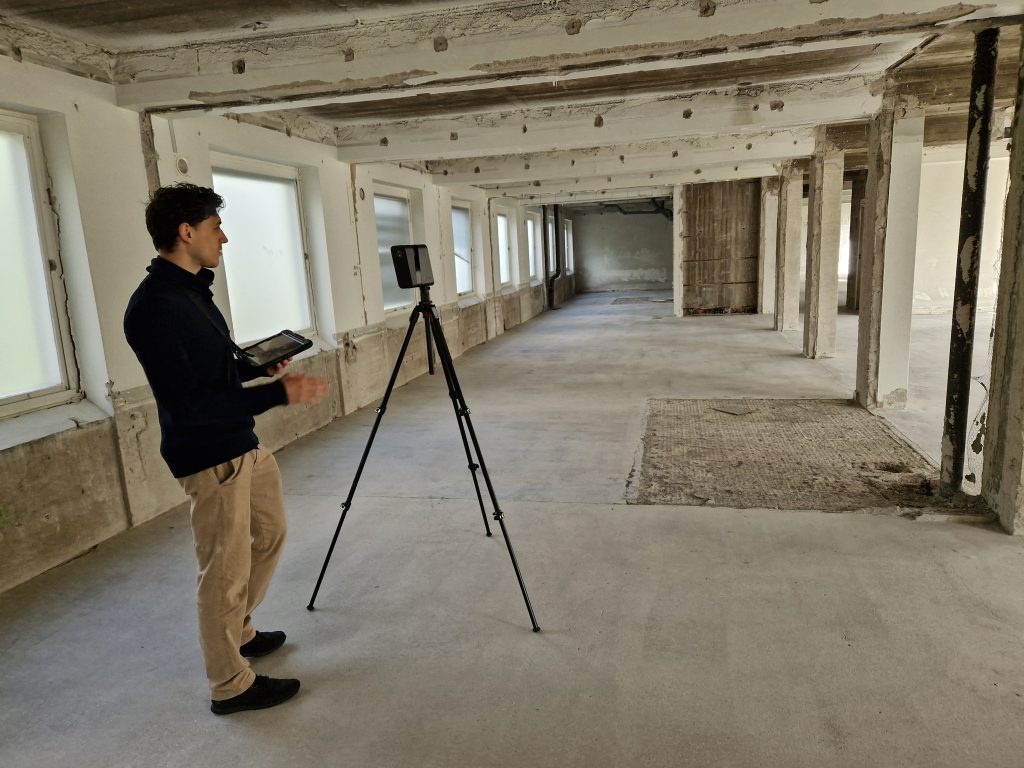
Results show a clear improvement in both speed and accuracy. A full digital inventory of the building was completed in around 4 hours, compared to approximately two days for a manual process. The most advanced method identified up to 5,148 kg of recyclable glass, compared to 3,887 kg through manual inventory, while also enabling CO₂ savings estimates of up to 2,728 kg.
By structuring material data and integrating it into the Reincarnate CP-IM platform, the demonstration shows how digital inventories can enable scalable circular value chains and better decision-making in demolition projects.